
Danielle Blacklock
Director of the NOAA Fisheries Office of Aquaculture

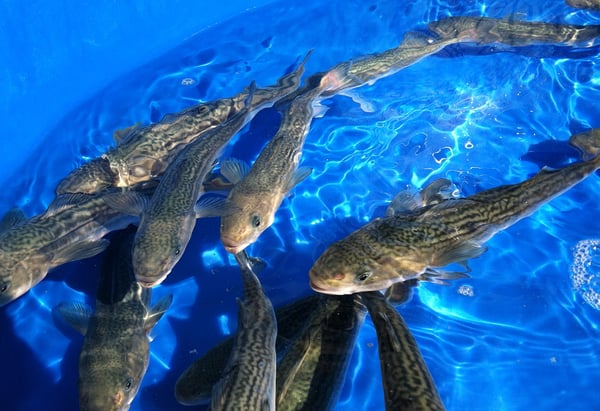
NOAA scientists are farming sablefish, a deepwater species native to the Pacific Northwest and Alaska, to bring the species to commercial viability for U.S. fish farmers. Photo: NOAA Fisheries
In 2022, for the first time in history, more global seafood was produced through aquaculture than was harvested from the wild. Wild capture will always be a critical part of seafood production, but with the growing demand for seafood worldwide, farmed fish will play an increasingly important role in the future of seafood. Aligned with the Executive Order Restoring American Seafood Competitiveness, NOAA supports restoring American seafood competitiveness and strengthening domestic seafood production. Our continued actions to champion aquaculture ensure that the United States will be a dominant world leader in farmed seafood today and into the future.
Each year, Americans eat roughly $15 billion in farmed seafood imported from other countries. But American seafood supports American jobs, and follows safe labor and environmental standards that are often not enforced in other countries. When you buy American seafood, wild-caught or farmed, you know you’re making a responsible choice for your family.
NOAA is advancing a sustainable future for domestic seafood farming. In the 1980s, up to 70 percent of salmon feed was made up of fishmeal, made from wild-caught fish. Not only is catching fish to feed fish expensive, but importing fishmeal from other countries can have serious environmental impacts.
The NOAA-USDA Alternative Feeds Initiative helped change this—by 2017 only 25 percent of feeds consisted of fishmeal. Plant proteins, like American-grown soy, bolstered this progress.
The U.S. is poised to become a global aquaculture leader. The scientific expertise and dedicated mission of NOAA’s Office of Aquaculture is ready to promote the exciting growth of sustainable U.S. aquaculture.
NOAA employs preeminent global aquaculture leaders, including marine spatial planners, policy and permitting experts, aquatic animal health specialists, physiologists, ecologists, geneticists, veterinarians, statisticians, extension agents, and communication experts. Our public servants leverage NOAA’s cutting-edge science and technology to propel the U.S. aquaculture industry as a dominant force in global markets.
One way NOAA is working to expand aquaculture markets and bring healthy protein to American families is by pioneering new farmed species. Scientists at the Northwest Fisheries Science Center are working with industry partners to bring sablefish, or black cod, to economic viability for aquaculture. Part of this research examines the effects of plant-based and fish-based feeds for farmed sablefish. For the first time, scientists are examining the gut microbiomes of sablefish reared on a diet made primarily of soy proteins. Subsequent research has found that supplementing taurine in sablefish diets helps with the absorption of plant proteins, improving growth and health outcomes.
To invest in cutting-edge scientific solutions, NOAA recently announced $9 million of initial funding for a new research partnership: the Cooperative Institute Fostering Aquaculture Research and Marketing. CIFARM will have a broad geographic scope and will advance science through engineering, technology, modeling, risk assessment, socioeconomics, market research, and other bold research that drives the U.S. aquaculture industry forward.
NOAA is committed to improving opportunities for American fishermen and seafood farmers. One of NOAA’s most important roles is helping growers get aquaculture farms in the water. Our regional aquaculture coordinators work directly with farmers to help them navigate the permitting process, while our policy experts strengthen collaborations with our state and other federal partners to increase regulatory efficiency. One of the ways we’re doing this is by identifying Aquaculture Opportunity Areas for shellfish and seaweed aquaculture in Southern California, the Gulf of America, and Alaska.
Our process for identifying Aquaculture Opportunity Areas uses cutting-edge science, marine spatial planning, and stakeholder engagement to find ocean spaces that are suitable for multiple commercial aquaculture projects. Deciding where to put a farm is one of the biggest hurdles for growers to clear.
This summer, NOAA will identify thousands of acres of Aquaculture Opportunity Areas in the Gulf of America and Southern California, opening the door for offshore aquaculture development. These areas will give farmers a boost by taking the uncertainty out of selecting a site. They will create jobs, uplift coastal economies, and complement wild-capture fisheries to produce more American seafood.
As Americans, we have a responsibility to bolster our domestic seafood supply and uplift our coastal communities. The positive impacts of expanding the American aquaculture industry will be felt across the country, from the vast ocean waves to the expansive soybean fields. An increased demand for American-grown soy in fish feeds will bring revenue to farmers in the heartland. New fish farms in coastal communities will help to retain historic working waterfronts and bring high-paying year-round jobs.
And most importantly, America-first aquaculture production will help put more affordable, healthy, and sustainable fish on American plates.